

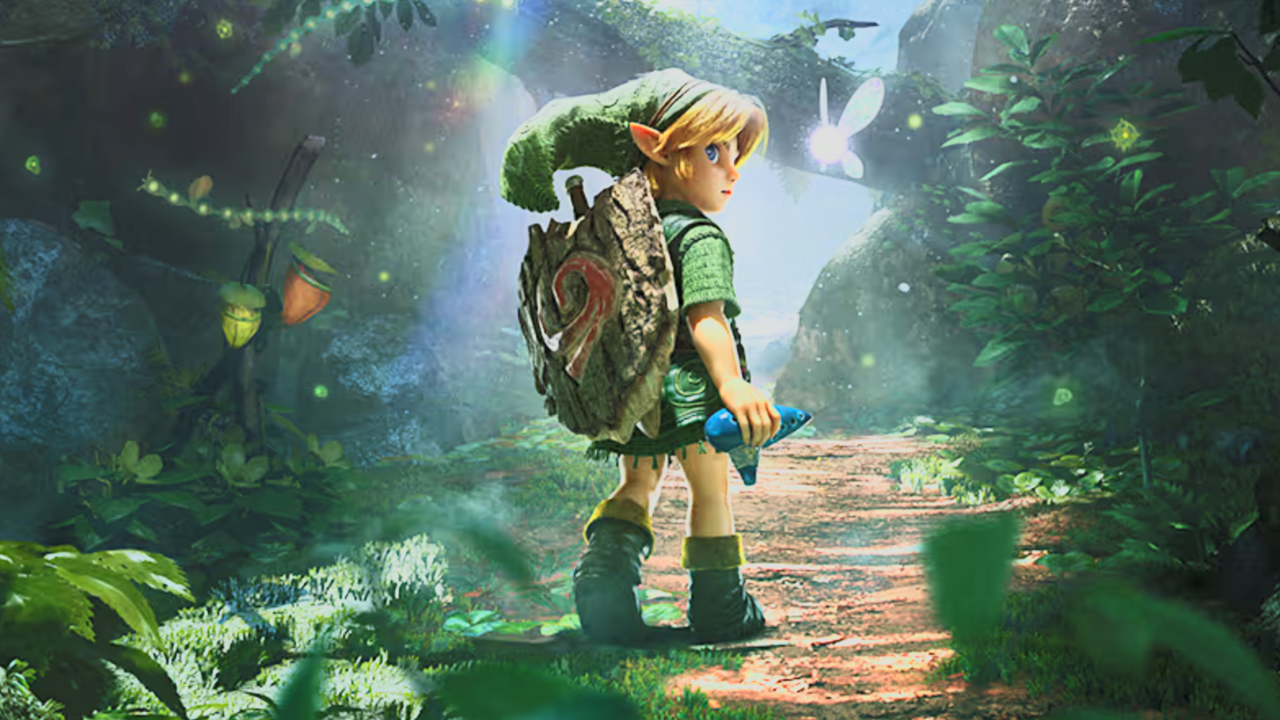

The Legend of Zelda: Ocarina of Time remake is framed as a legend retold. It opens on a tapestry depicting Hyrule’s people and places, as a narrator reflects on Link’s journey like it’s a valuable story worth passing down. For Zelda producers Eiji Aonuma and Hidemaro Fujibayashi, a desire to pass the original game down to a younger group of Zelda developers is one of the main reasons this remake exists:
“There are much younger developers who are working on this game, and I do think this is a really valuable experience for them to familiarize themselves first with the original Ocarina of Time and then have their own reinterpretation of it,” Aonuma said. “And to have those conversations throughout the course of development that may aid them in future projects as well.”
This is just one way the pair is reflecting on this franchise they’ve spent decades working on. I spoke to Aonuma and Fujibayashi for nearly an hour ahead of the release of Ocarina of Time, and we discussed the elements that make a Zelda game, how real-world inspirations and expertise play into game development at Nintendo, and their strongest memories and reflections as the Zelda franchise celebrates its 40th anniversary. Read on for my full conversation, including one of Aonuma’s key memories with Zelda creator Shigeru Miyamoto: “Hey, Mr. Aonuma, you know you can’t really cut a wooden crate with a sword, right?”
IGN: It is great to meet you both. I’d like to start by congratulating you on tonight’s launch of the Legend of Zelda: Ocarina of Time, as well as the 40th anniversary of The Legend of Zelda.
Both: Thank you.
IGN: The opening cutscene of Ocarina of Time’s remake and its tapestry present this remake as a legend being passed down. I can’t help but think of the parallels with its development. Mr. Aonuma, you said that you wanted your team to understand the significance of Ocarina of Time. In a way, you’re passing down a legend of your own, and I’m wondering if this connection was on your mind throughout development.
Eiji Aonuma: So the specific cutscene with the tapestry was not necessarily something that I had created with that in mind in terms of handing down a legacy, as you say. That was something that developers who were working more directly on the game contributed to. But for me, certainly as you mentioned, there are much younger developers who are working on this game, and I do think this is a really valuable experience for them to familiarize themselves first with the original Ocarina of Time and then have their own reinterpretation of it. And to have those conversations throughout the course of development that may aid them in future projects as well.
IGN: I’d like to ask about that more because one of my takeaways from this game is how much value I find in the traditional 3D Zelda formula, and you’ve said newer developers understanding the structure is one of the purposes of this remake. But it’s also caused you both to revisit this traditional Zelda formula after several years away. Revisiting it with fresh eyes, what positive aspects of this more linear type of 3D Zelda have stuck out the most?
Hidemaro Fujibayashi: As you mentioned, Ocarina of Time perhaps could be described as simpler. And going back to Zelda as a whole, regardless of whether it’s an old Zelda game like the initial original Zelda or newer ones, I think the core of what makes a Zelda game, from my experience and thinking, is that it’s the combination of exploration and discovery. And that’s something that has been with the Zelda series, starting from the very first Zelda game all the way to recent games like Tears of the Kingdom. And I think that’s a common through line. And even as we’ve gotten into newer games that have the open-air gameplay style, it becomes a little bit more complex. But as we return to a more focused 3D Zelda experience, as you mentioned, it’s kind of given us an opportunity to bring the comforts and the play styles of the modern games.
For example, having a second control analog stick so that you can control the camera. That really eases the experience of gameplay so that coming back to a more straightforward, focused experience really allows the player to focus on the core aspect of Zelda, which, again, is exploration and discovery. And so there’s almost this multiplicative gameplay that allows you to dive even deeper into the idea of exploration, discovery. And that’s something that I really felt like I kind of reconfirmed within myself that that is really what makes a Zelda game a Zelda game.
IGN: I’d love to know when this project started development. Mr. Aonuma, you’ve mentioned that this was a great way to celebrate Zelda’s 40th anniversary. I’m wondering when the idea came up and if it was before or after Tears of the Kingdom was released.
Aonuma: It’s hard to say exactly when the decision came about to remake Ocarina of Time in this way. I do believe it was after the Tears of Kingdom development had ended, we started to see staff being released to other projects that we were talking about the 40th anniversary timing coming up, and what would be best to celebrate an anniversary like this. So as we were discussing it and looking back over the Zelda franchise through the years, we talked about Ocarina of Time being a really good starting point for a lot of people who have played the franchise, and my professional starting point with the series as well. And I was really curious to see how the younger generation of developers at Nintendo would interpret a game like this for a new generation, for new players. So it’s a little hard to nail down the exact timing because there were so many steps along the way, but I do believe it was after the development of Tears of the Kingdom had finished.
IGN: Mr. Fujibayashi, I noticed this was your first time serving as producer on a Zelda game after directing the last few. What was that transition like for you? Was it difficult to take a step back in any specific situations?
Fujibayashi: Even though my role on this title has been producer, I feel like my producer role has been relatively close to the front lines of development. But in terms of maybe a challenge that I faced was, because we now have a younger staff that’s working with us, when I’m discussing things like what makes a Zelda or when I’m trying to provide advice or guidance, we have such a vast range of ages in our team. And some of the language we use or some of the way we communicate is a little bit different. So I found myself needing to adjust and recognize if this person has been involved with the series for a long time or if this person is new to the series. And adjusting the way I provide advice or, say, be involved with ideations with those people, I really felt like I had to kind of pull out my wisdom to make sure that the communication works for the person that I’m speaking to.
IGN: I’ve finished Ocarina of Time on Switch 2, and I really loved it. What struck me was the intertwining of these two eras that you’ve mentioned of modern presentation and controls through an old-school Zelda world. And I found this overlapping muscle memory of, originally I would expect Link to auto jump and he didn’t and I fell. Or, I thought I could climb a rock and I couldn’t. My brain was pulling from Breath of the Wild and pulling from the original Ocarina of Time. What’s something that sticks out to you about blending these two eras of Zelda together that makes this remake special?
Aonuma: There were certainly a lot of moments in development where our younger developers on the staff were considering how to familiarize and reinterpret the original Ocarina of Time. And we didn’t tell them what to do in terms of “change this or don’t change that,” but rather they would come to the experience and try to feel a natural need for something. And I think two examples are both shifting to a manual camera control, and an auto jump system, where they decided that it was justified to make a change. Now, of course, in some cases, this might mean that you’re adding additional review that’s necessary because you have to control player access if they can jump absolutely anywhere. But I do believe that it adds a greater feeling of freedom compared to the original jump system in the game. And I hope that that is something players find to be a really good fit. I know that if they are more recent Zelda players who have a lot of experience with Tears of the Kingdom and Breath of the Wild, that’s perhaps going to feel like a more natural choice for them.
In the end, those decisions around manual camera and freedom of jumping, I think bring a certain freshness to the remake while still maintaining a lot of the feel of the original. So I hope that both returning players like yourself who are very familiar with the original as well as completely new players are going to find something fresh or invigorating about that experience. But certainly I had a few moments where I fell into some deep pits myself, so don’t worry. [Laughs]
IGN: [Laughs] I was admiring the new motion aiming, which feels great. And then I walked right off a bridge. So you’ve said that you left it to the team to make any changes they felt were necessary. Was there anything from the original Ocarina of Time that was untouchable and had to stay the same?
Fujibayashi: There isn’t one specific “this” or one specific “that” we wanted to change, but as we started up on the development of this game, there was obviously the younger staff that were basically the directors for the game. One thing we made sure we did right off the bat is really clearly define what we’re going to change, what we’re not going to change. And when it comes to what we wanted to change, we wanted to encourage the team to really leverage the capabilities of the Nintendo Switch 2 hardware. That leads to things like the ability to control the camera or the ability to jump anywhere. It also goes into things like renewing the graphics in its entirety and increasing the quality of the sound. Like for example, in this title, all of the background music is in 5.1 channel surround sound.
So if you listen to the game with headphones on, it really provides an immersive experience. And then going to the things that we weren’t going to change, we really thought about, “Okay, what was it that the original Ocarina of Time development team wanted to convey? What’s the experience that they wanted to convey through this game?” And that’s what we focused on as something that we want to convey as is. And those are the two kind of guiding principles as we began development.
IGN: So Mr. Aonuma, you’ve mentioned that you would hold lectures along the way during this game’s development. What’s an example of what those lectures would be about? And were these scheduled or were these spontaneous talks that you had with the team?
Aonuma: So I would say these were less teaching lectures and more discussions where I was really asking them how they felt playing the original, how they were interpreting it. And that led to so many moments where I would see how they were interacting with it and say, “Oh, if you feel that way, then feel free to suggest a change in that area that would address the thing that you’re seeing.” So I didn’t want anyone to be too conscious of rules like I was laying down the law in that sort of sense. Most of these conversations I would say were probably with the directors and it was often a matter of like, “So I understand how you feel playing the original. Is that something that you would want to change?” And sometimes they were the ones who would come back and say, “No, I don’t want to change it.” I feel like we had a repetition of that kind of series of conversations over the course of the project.
IGN: Was there a specific moment where a younger team member approached you with something about the original Ocarina of Time that made you think about it in a new way?
Aonuma: I think for me, something that stood out about a lot of these conversations with these younger developers about how they were interpreting the original game, is they would sometimes come to me and say, “Okay, I can tell that this aspect is really important.” And they would describe something that hadn’t necessarily been part of our thinking or our intent at the time. So in my mind I’m thinking, “Oh no, it’s not really important in terms of an intentional thing that we were going for.” But because they had that reaction, because they had that feeling, that’s what was important. And so, in the moment, I can’t say, “Oh no, that wasn’t important.” I listen to them and I say, “Okay, I see how that was important to you and I see which direction it’s leading you to want to go and looking for a way to support the important part.”
IGN: Is there a specific example of that interaction that sticks out the most?
Fujibayashi: So there’s actually a million of those, probably way more than you would imagine. So it’s really hard to pick out one. Nothing really stands out as the one.
Aonuma: I agree. There’s probably too many of those kinds of incidents to pick one and really elevate that. But I will say that sort of as a category of this kind of interaction, something that we saw a lot in our conversations with younger developers as they were interpreting the original is a discussion of how to balance the amount of imagination that you are asking the player to bring to the gameplay experience, the amount of problem solving you want to allow them to do, that’s really deeply affected by the information gap you leave. And so we would have these level setting conversations of, “Okay, if you do too much here, you’re actually providing so much information to the player that they’re not going to make that jump and feel the satisfaction of it.” So there was a lot of balancing around how to leave exactly the right kind of gap for them to have a satisfying experience.
IGN: Mr. Fujibayashi, you said one of the things that makes Nintendo special is developers who pull from their own expertise outside of video games. And I really love that, I find that inspiring. And I loved hearing that the developers experimented with fabric and thread when designing the clothes in the remake. What’s a real world hobby, passion, or interest of yours that has influenced the Zelda series?
Fujibayashi: Because my involvement with the Ocarina of Time remake was not as a director, there’s nothing that directly impacted this game. But when it goes back to things like Breath of the Wild or Tears of the Kingdom, when I was directing the game, things like the kind of food that we put into the game or a lot of the survival aspects of those two games, I think may have took some inspiration from the fact that I grew up on the countryside, so playing around in the mountains, playing around the rivers, those kinds of very basic things that probably all people have experienced to some extent. I think that probably has impacted the way I approach some of the aspects of those games.
And I spoke about myself, but for this title, some of the designers, for example, as you mentioned, would go out into the real world to experience some of the fabric they might want to recreate in the game, or they might go check out some rocks outside in the real world to really create a world that seems like it actually exists. Those are things that I think, as you mentioned, are what makes Nintendo developers special, and what you said really holds true for this title as well.
Aonuma: One example of this that I was particularly interested in was the way that the animation staff approached recreating the movements of playing the Ocarina itself. They were studying actual people playing and in some cases, were an ocarina player themselves, to get the feel of it, to understand the movements of the hands and how to coordinate that in the animation.
IGN: That’s very cool. In the Ask the Developer, it was revealed that a “puppet show feel” and “analog practical effects films” were discussed during development. And I understand that in the original Ocarina of Time’s development, a field trip to a samurai stage show influenced the Z-targeting system. Did this anecdote come up at all during development of the remake?
Aonuma: You’re referencing what’s actually a very famous story within Nintendo during the development of the original Ocarina of Time. When people were approaching how to deal with the camera control during sword fighting scenes, before they came upon the idea of Z-targeting, they said, “Hey, let’s go see an actual sword fight at this movie village theme park,” I believe it was. And when they did so, they had this idea of like, “Okay, what if we fix the point that is orbiting around the target?” But I think more than that, what’s important is how this relates to the general idea of looking at the real world and finding a motif that you can bring into the game that is helpful to bring an additional sense of realism or immersion or ease of play there. And certainly there are many examples of that in Ocarina of Time, both in the original and the remake. And we’ve even seen developers bringing some aspect of their own personal lives or everyday life into the experience of the game as well.
IGN: I’d like to ask, of all the quirky side characters in Hyrule, I’d love to hear each of your favorites. Not main characters or sages, but the townsfolk you only talk to a handful of times. My favorite is the magic bean seller. I love how his sales pitch gains this bravado as the “demand” for his product goes up.
Aonuma: So for me, I think one thing that stands out as a fun subcharacter is Ingo at Lon Lon Ranch, who is, you’ll remember from the story, a bad guy, but not a real villain, let’s say. And this was a chance to draw out a little bit more of his story and the experience of him, but more than anything, coming to the remake and coming back after the change of time saying like, “Oh, he’s still alive.” There’s a kind of moment of joy for the player to feel that as well.
Fujibayashi: So for me, I think it’s Dampe. Even in the original game, he kind of has this unique aura because he’s obviously walking around in a graveyard, what is he doing there? And you assume that it’s just going to be a conversation, then the mini game starts and then the reward turns out to be something actually really, really great. So it was a very unique and surprising encounter. So that really stuck with me.
IGN: Were there conversations during development about including Master Quest or any additional content from Ocarina of Time’s original development that did not make it to the Nintendo 64 game?
Aonuma: So certainly anytime that we release a game, if there’s an opportunity for the devs to consider what might come in the future, we want to leave that possibility open to them and support their interests. But I don’t think that we would announce anything specific at this time. But one thing that is a new element that I think is interesting to bring up is the Hall of Fallen Foes, which you would have not remembered from the original Ocarina of Time, but having defeated enemies in the world, you can then see models of them, see descriptions, and even recreate some boss battles.
IGN: I’d like to wrap up asking a couple of questions about Zelda’s 40th anniversary as a whole. In playing Ocarina of Time, I came to a similar realization as Mr. Fujibayashi, that Zelda games are about exploration and discovery no matter top down, 3D, open air, whatever form they take. Looking back on the last 40 years of The Legend of Zelda, which you’ve both been a significant part of, what’s the biggest reflection about the series that’s been on your mind?
Aonuma: So when we talk about what makes the core of the Zelda experience, there’s one anecdote that I do want to relate where Mr. Miyamoto came to me late at night and he said, “Hey, Mr. Aonuma, you know you can’t really cut a wooden crate with a sword, right?” And I was thinking to myself like, “Why are you coming to me when you’re so busy with something like this?” But I think that really goes to the core experience of Zelda style gameplay where you want to see something that is relatable from real life. You have the predictability of how things might work in the real world and you can use that to intuitively consider what might happen in the game. There’s a lot of satisfaction that comes from that. Even being able to slice a sign and then see the pieces float away in the water, that can be really satisfying for people, knowing that there are consequences to your actions that are predictable from your own real world experience and might lead you to think, “Oh, what else could I do in this game that I could do in the real world and would be predictable?” So anytime you can create that kind of experience for the player, I think it has a real impact in terms of bringing them into thinking about their actions in the game.
Lots of things that you can do certainly in recent games, if we consider Breath of the Wild and Tears of the Kingdom, the physics system allows you to recreate so many kinds of interactions in the world that maybe you might be able to do in the real world as well. When we connect that to another part of the core of the Zelda franchise, which is exploration and discovery, you have this cycle of you look for a thing, you think about how to address the thing, you make a discovery, and then you think about where to go from there. And I think those are the values that all link together to support this sense of what is the essence of The Legend of Zelda franchise.
IGN: Besides Ocarina of Time, which Zelda game is the most special to each of you?
Aonuma: So special, it’s interesting. Let me see. Since we’ve been talking about the development of Ocarina of Time, maybe it’s good to acknowledge the source of some of the ideas that I brought to the development of that project. And for me, this would be The Legend of Zelda: A Link to the Past. I think before playing that game, to me, games were something that you either win or lose. And once I started to play A Link to the Past, that’s when I started to realize they could be something else entirely. They could be a game that has a fully fleshed out world feel, something that seems so real, you can almost touch it. And I felt the impact of exploration and discovery in that game. Once you have that moment of realizing like, “Oh, you can do that in this game,” that’s what inspired me to think about how to make games that gave the same kind of experience to players in the future.
And I was very fortunate to then be pulled into a Zelda project after that. So in that sense, I would say A Link to the Past is very special to me in that regard. If Ocarina of Time was my professional start with the Legend of Zelda franchise, then perhaps A Link to the Past is the origin of a lot of the ideas that I brought to it.
Fujibayashi: When we talk about a title that’s special to me, usually I answer what is kind of my prime point, my original point with Zelda, and I always respond with the first initial original Zelda. But when it comes to something special to me, I think it might be Skyward Sword. And that has to do with some of the hardware limitations, actually. The idea of jumping from the sky, diving all the way down to the ground or being able to climb anywhere, those were, and through that, basically removing the idea of a set course or how to navigate a game, all of that was something that we wanted to do, but I wasn’t able to do because of the hardware limitations. But that idea, the core ideas of that type of gameplay was there, which ultimately turned into an open-air game play style like you see in Breath of the Wild and Tears of the Kingdom.
So really I think since after that, now that we had Nintendo Switch, the hardware allowed us to do the things that I wanted to do then. And when I say it that way, it might sound like these were just restrictions and a negative experience, but it wasn’t so in that all of those hardware limitations really allowed me to think creatively. And I feel that I was able to really imagine the game I wanted to create and the game that took shape was Skyward Sword, but also the ideas that shaped Breath of the Wild and Tears of the Kingdom were also kind of born at that point.
IGN: I agree. I think there’s beauty in limitation. Thank you both so much. I appreciate your time, and congrats again. It was great speaking with you both.
Thanks for reading. While you’re here, check out my full review of The Legend of Zelda: Ocarina of Time.
Editor’s note: parts of this interview were edited for length and clarity. We were also not permitted to ask about specific projects outside of Ocarina of Time.
 The Legend of Zelda: Ocarina of Time Remake Full English Voice Cast Revealed
November 5, 2026
 Adam Driver Confirms His Role in Heat 2, Comments on Recent Michael Mann Shooting
November 5, 2026
 John Constantine Movie From Evil Dead Wrath Filmmaker is in Development at DC
November 5, 2026
 Captain Price Actor Barry Sloane Says He's the Most Qualified Person to Star in the Call of Duty Movie
November 5, 2026
 World of Warcraft Forever Launch Live Blog: It's Looking Like a Smooth Blizzard Launch
November 5, 2026
 Scarlett Johansson Says The Batman: Part 2 Role Caused 'Existential Angst'
November 5, 2026
 US Elections: அமெரிக்க செனட் வரலாற்றில் முதல் தன்பாலின ஈர்ப்பாளர்; இணையுடன் மேடையேறிய கிறிஸ் பப்பாஸ்
November 5, 2026
 How the work of two Nobel Prize winners can guide policy in an uncertain world
November 5, 2026
 இடைத்தேர்தல் ரேஸ்: ED போடும் பிரஷர்… விராலிமலையை வசமாக்க முயற்சியில் 'ரசகுல்லா' விஜயபாஸ்கர்!
November 5, 2026
 Why Irdai's proposed commission rules could distort insurance market competition
November 5, 2026
The Legend of Zelda: Ocarina of Time Remake Full English Voice Cast Revealed
November 5, 2026