

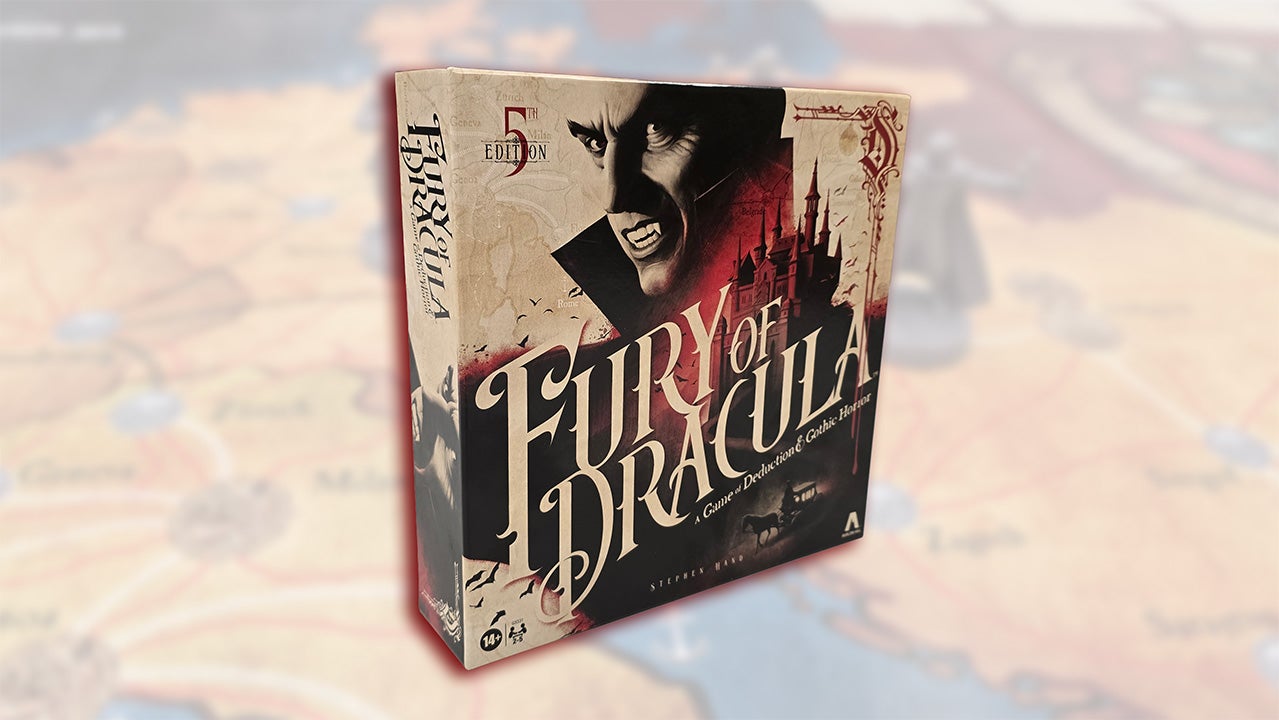

The “hidden movement” genre of board games is one of my favorites and I still remember where I discovered this type of game. I was watching Wil Wheaton’s “Tabletop” series, when the game of the week was “Fury of Dracula”, a game where one person assumes the role of Dracula, spreading terror and attempting to grow his vampire forces around the globe, while the others are vampire hunters, try to track him down and drive a stake through his heart. Despite falling in love with what I saw, it was unfortunately at a time when Fury was out of print, and while eventually I would find myself a copy, it remained a rather sought after game for fellow hidden movement fans. Thankfully, at long last, the good folks at Avalon Hill have brought it back in a brand new 5th Edition, and fans around the world can once again hunt down dracula during their next board game night.
For those familiar with either the Fantasy Flight Games’ 3rd or WizKids’ 4th editions, the 5th edition is largely the same but for everyone else, Fury of Dracula is a one-versus-many with one person playing as the count and up to four other players controlling the hunters. As I mentioned a moment ago, this is a hidden movement game, where Dracula will be moving around the map, placing cards face down noting where he is and was, leaving dangers in his wake, while the hunters try to trap and kill the vampire lord. Each round, consisting of a Day and Night phase, begins with the hunters moving, supplying themselves with tools and special event cards, purchasing travel tickets, or searching for their target. During the day, these actions are generally safer, while attempting to resupply invites potentially hazardous events that may help Dracula instead.
Dracula’s turn is a bit less eventful, but debatably more important. Once all the hunters have taken their nighttime actions, Dracula is then able to move to a new location, placing face down a new location card on their growing trail and an encounter card. These encounters, secret much like the locations themselves until a hunter uncovers them, may spawn enemies, create diversions and delays for the hunters, or worse. Should one of these ever move off the board, “maturing” as it’s referred to, the despair track will increase, putting Dracula that much closer to securing his victory!
Unlike other hidden movement games, such as Whitehall Mystery (another personal favorite of mine) that is purely a game of cat and mouse, Fury of Dracula incorporates a combat mechanism. During situations where the hunters have cornered Dracula, both sides pick a card from their hands, composed of moves or helpful items like holy bullets and pistols on the side of the hunters, and then flip them, then resolve their effects. Despite the rather simplistic nature of these fights, it also has led to some of the tensest moments in board games I’ve ever had. Moments when misreading my opponent led them to safety, or one especially board-flipping time when I expected Dracula, who being only one hit away from death, to flee, only to have him decide to bite and knock me out instead. A defeat that pushed the despair track past its end, and handing the win to Dracula. Utterly infuriating, but also one of the aspects of Fury of Dracula that sets it above many other hidden movement games for me.
In addition to redone artwork (more on that in a bit), this new fifth edition does offer a couple of optional new elements that can shake up the formula a bit for those Fury vets out there. First is the addition of a fifth hunter to pick from, Jonathan Harker, who previously had been relegated to just an ally card. Mr. Harker now can be picked to replace one of the other hunters, and has some powerful abilities that should certainly help the good guys out. He’s able to not only deal additional damage when hitting Dracula but also, similar to his wife Mina, can force him to announce if Jonathan is in an adjacent spot. While a neat addition, it also feels like a bit of a halfbaked attempt too. Unlike the other hunters, Mr. Harker doesn’t get his own unique event card, and instead can simply use the one made for the hunter that he replaces. The balance of the game also doesn’t quite feel like it’s been balanced for him, and I found that when both Harkers were on the board, with their tracking talents, it made for a decently harder time for Dracula. He’s a fun “sometimes” change, but I plan to stick with my normal squad for most games.
Fury of Dracula is typically a game that can take a surprising amount of time, with some games I’ve played lasting past the four hour mark, and the second new addition with 5th edition is a faster game mode that can cut that in half or more. This new faster variant removes a couple of cards and blocks off a couple of the regions of the map (damn that Black Plague) while setting the board state roughly around where it would be after a “week” (about a third of the way through), granting hunters some items to start, Dracula with some damage, despair up a bit, and a few other tweaks. By-and-large I found this new variant to be a solid choice and makes Fury of Dracula a much more viable option on a weeknight. The smaller region and other adjustments (such as the instantaneous water movement and removing the single value train tickets) can make things far more swinging where getting away and staying hidden as Dracula can be more challenging. Again, just like with Harker, it works, but I’m curious how much balance testing went into it.
As one would expect from a new edition of a game, it isn’t usually just the gameplay or mechanics that get a refresh, but the artwork too, and it’s here where the 5th edition sees its biggest departure. Not because the map changes (though the town of Whitby, which plays an important role in the story of Bram Stoker’s original Dracula novel, is finally included) but the aesthetic has changed. And it’s also here where I think the new edition takes a step backwards from the third and fourth editions.

With exception of Dracula’s location cards, the artwork for the event, encounter, item, and combat cards all have ditched the dramatic and detailed full color artwork of the earlier iterations in favor of what I would describe as drawings you may see in an old Victorian-era newspaper. These black-and-white illustrations work, but just don’t have the same impact, with some appearing, dare I say, even a bit corny? The “Dark Call” card for example, now features Dracula staring at the moon with a few bats in front of him, compared to earlier versions where he appears to be basking in the night with hordes of bats all around, against a stormy sky. Then there is the new “Misdirect” which basically makes him look like Batman from The Animated Series, as opposed to a mysterious man in a top hat, lurking in the fog. Hunter and Dracula character cards don’t fare much better either, with the portraits replaced with sepia-tinted photographs of the character. Which, now that I think about it, could you even take a picture of Dracula? I mean, vampires don’t have reflections in mirrors, so can you photograph them? Oh well, questions for another time.
 Before HBO’s The Last Of Us, An Entirely Different Adaptation Was Proposed
September 5, 2026
Onimusha WOTS – High Level Gameplay On Hardest Difficulty
September 5, 2026
Before HBO’s The Last Of Us, An Entirely Different Adaptation Was Proposed
September 5, 2026
Onimusha WOTS – High Level Gameplay On Hardest Difficulty
September 5, 2026
 How To Complete The Cycle Of Love In The Blood Of Dawnwalker – Xanthe Boss Guide
September 5, 2026
How To Complete The Cycle Of Love In The Blood Of Dawnwalker – Xanthe Boss Guide
September 5, 2026
 You Can Extend The Blood Of Dawnwalker’s Time Limit By Finding Sanzhani Fairies
September 5, 2026
You Can Extend The Blood Of Dawnwalker’s Time Limit By Finding Sanzhani Fairies
September 5, 2026
 Taylor dominates Pili in final fight of career at Croke Park
September 5, 2026
Taylor dominates Pili in final fight of career at Croke Park
September 5, 2026
 'We've got one hand on it!' – Partington on Super League title chances
September 5, 2026
'We've got one hand on it!' – Partington on Super League title chances
September 5, 2026
 Papers: Saudi move most likely for Richarlison
September 5, 2026
Papers: Saudi move most likely for Richarlison
September 5, 2026
 Swansea miss chance to go three points clear with Wrexham draw
September 5, 2026
Swansea miss chance to go three points clear with Wrexham draw
September 5, 2026
 Wigan thrash Leeds to take control of Shield race
September 5, 2026
Wigan thrash Leeds to take control of Shield race
September 5, 2026
 Allen fight ends in bizarre fashion as Carty falls through ropes in round one
September 5, 2026
Allen fight ends in bizarre fashion as Carty falls through ropes in round one
September 5, 2026