

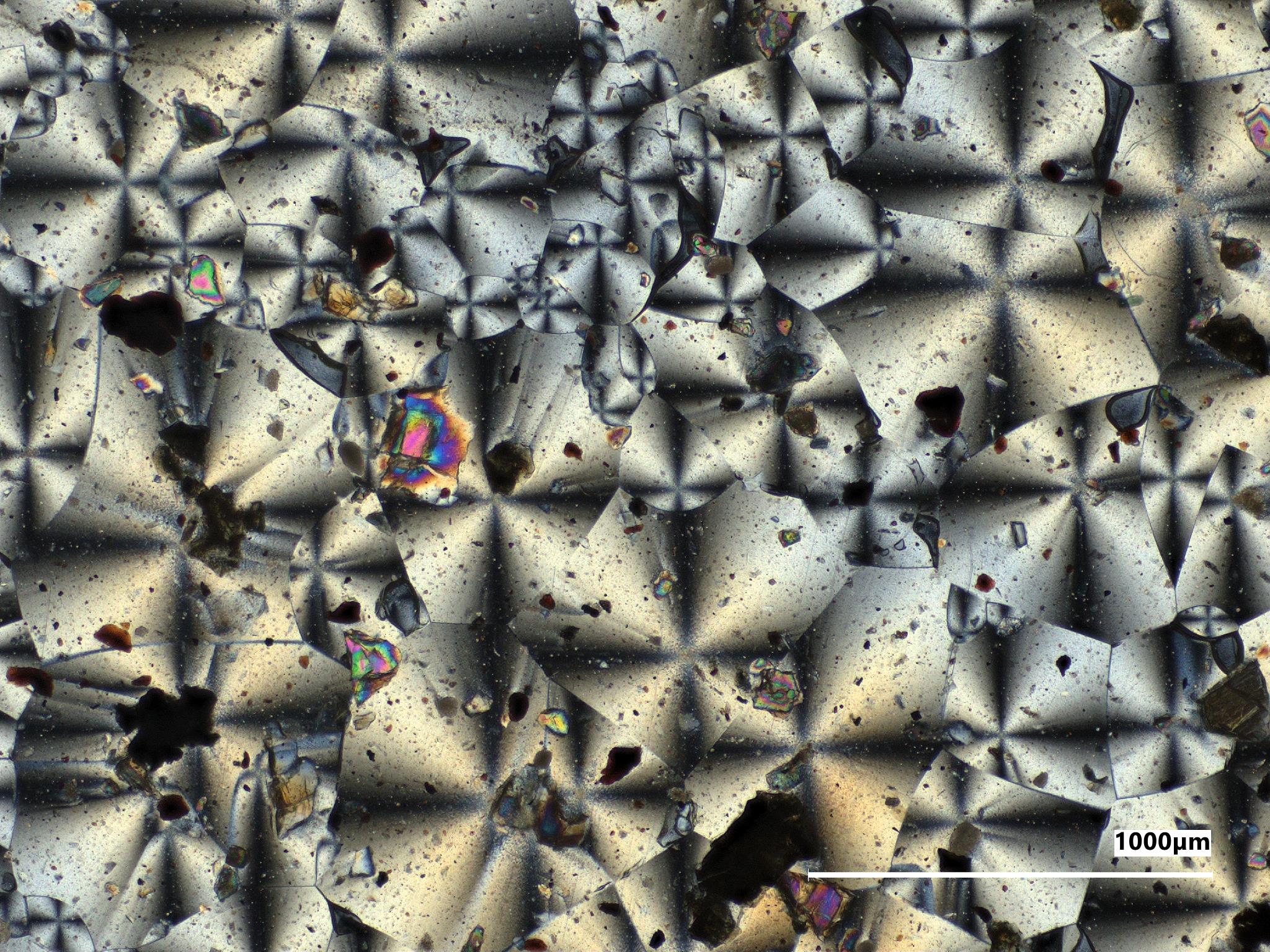
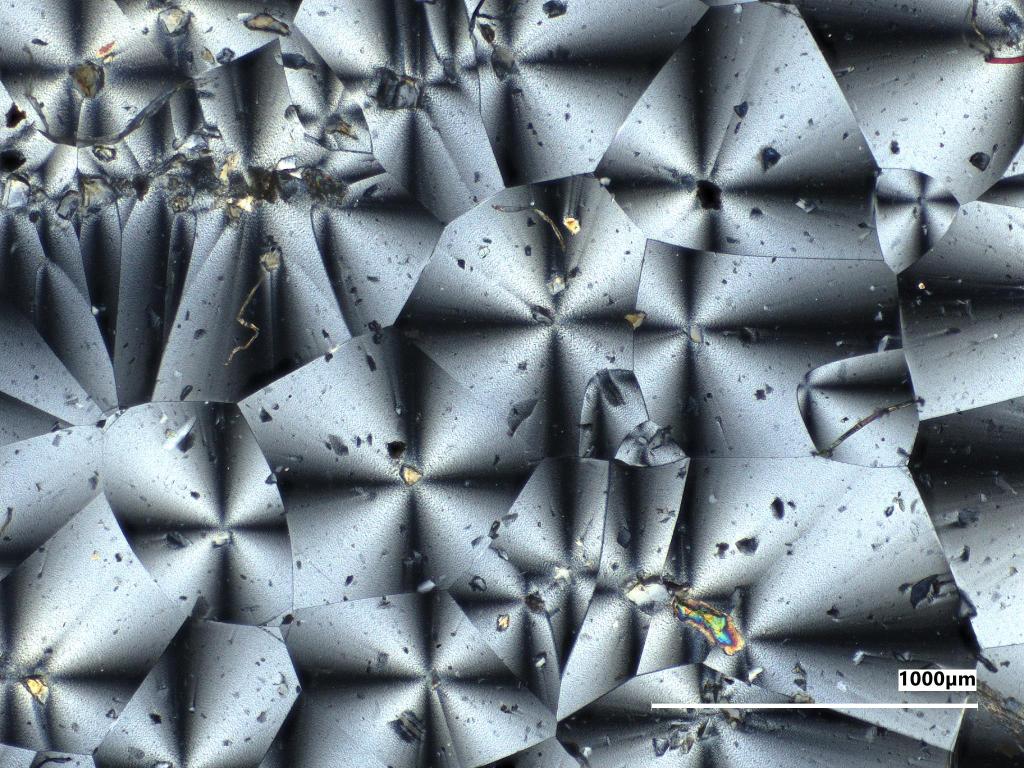
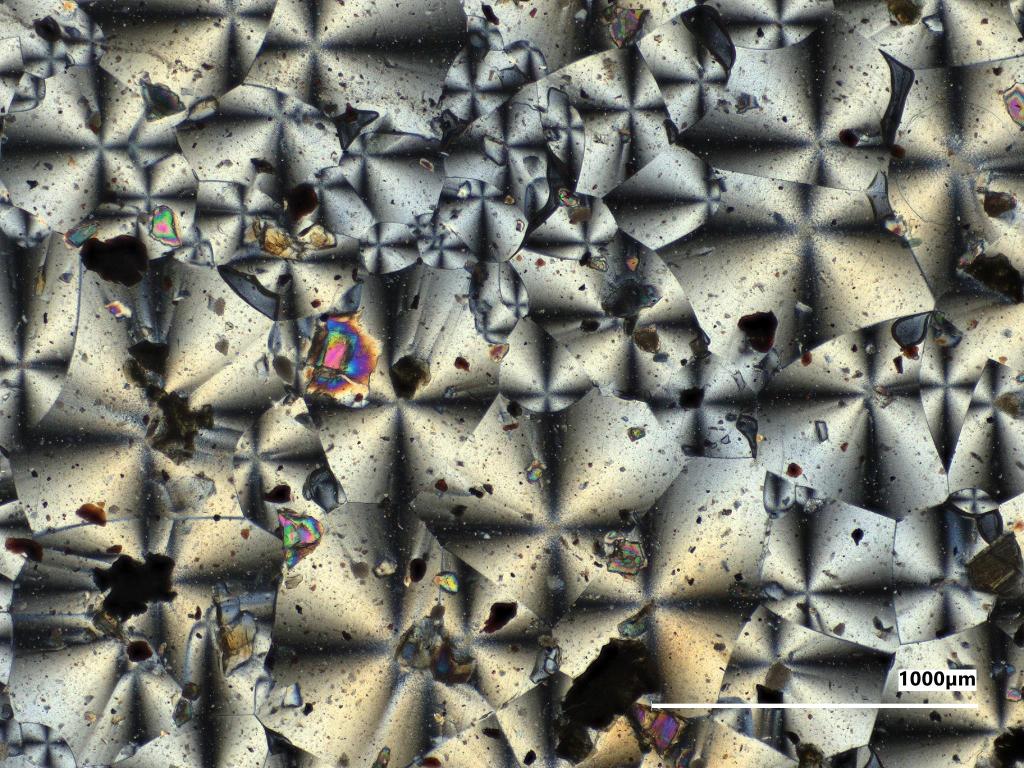
Photos taken using a microscope reveal the colorful, kaleidoscope-like crystal structure of a new NASA-made material that could be used for manufacturing during future space missions. Developed at NASA’s Glenn Research Center in Cleveland, the material could be created directly on the Moon or Mars, allowing NASA to pack fewer supplies — saving weight and reducing launch costs.
To make the material, research chemical engineer Allison Christy and her team of summer interns at NASA Glenn — Tyler Klinchuch, Ethan Bilodeau, and Emma Levenson — mixed a special plastic with simulated Moon and Mars dust. This plastic is biodegradable and could be produced by bacteria fed with crew waste or carbon dioxide.
“The plastic literally grows within the bacteria’s little bodies,” Christy said. “It’s really cool.”
The team found that incorporating simulated lunar and Martian dust particles into this plastic made it stronger and easier to process. Adding different types and amounts of dust allowed them to adjust the material’s properties. The gray image shows sample material manufactured using mock Moon dust, while the reddish image shows material made with mock Mars dust.
The material could be used to manufacture equipment used inside future Moon or Mars habitats, like structural brackets, wrenches, or chairs. By potentially enabling on‑demand, fully recyclable fabrication with lunar surface material, this could help advance NASA’s objective of a permanent Moon Base by reducing resupply needs and empowering crews to build and repair essential equipment on-site.
“You can’t just bring everything with you to the Moon or Mars,” Christy said. “If something breaks, you have to find a way to fix it with what you have. This is a very versatile material, which is a huge benefit.”
Going forward, the team hopes to analyze whether this material could also be used outside in the harsh environments of the lunar or Martian surfaces.
The material is now undergoing testing in Glenn’s Lunar Environment Structural Test Rig to see how it holds up in extreme temperatures. Several samples are also slated to launch aboard the upcoming Materials International Space Station Experiment 23 (MISSE-23) mission and will be exposed to intense conditions outside the station.
This research is funded through NASA Glenn’s 2026 Center Innovation Fund, which is managed by the agency’s Research and Technology Mission Directorate.
Learn more about the program:
https://www.nasa.gov/center-innovation-fund/
 APOD: 2026 September 30 – Arp 78: Peculiar Galaxy in Aries
September 30, 2026
APOD: 2026 September 30 – Arp 78: Peculiar Galaxy in Aries
September 30, 2026
 Powerful Storms Continue to Prowl the Pacific
September 30, 2026
Powerful Storms Continue to Prowl the Pacific
September 30, 2026
 NASA Opens 2027 Human Lander Challenge for Lunar Communications
September 29, 2026
NASA Opens 2027 Human Lander Challenge for Lunar Communications
September 29, 2026
 NASA Awards Orbital Safety Analysis Support Services Contract
September 29, 2026
NASA Awards Orbital Safety Analysis Support Services Contract
September 29, 2026
 NASA Features Exploration, Science at International Space Conference
September 29, 2026
NASA Features Exploration, Science at International Space Conference
September 29, 2026
 NASA Adds Blue Origin New Glenn 9×4 to Launch Services Contract
September 29, 2026
NASA Adds Blue Origin New Glenn 9×4 to Launch Services Contract
September 29, 2026
 PM: I'd be 'really concerned' if Man City owners sell club
September 30, 2026
PM: I'd be 'really concerned' if Man City owners sell club
September 30, 2026
 Grooming gangs inquiry expanded to Birmingham and Wales
September 30, 2026
Grooming gangs inquiry expanded to Birmingham and Wales
September 30, 2026
 UK-France 'one in, one out' migrant scheme scrapped
September 30, 2026
UK-France 'one in, one out' migrant scheme scrapped
September 30, 2026
 This blog could help you poop better
September 30, 2026
Gill 223 sets up record chase for India
September 30, 2026
This blog could help you poop better
September 30, 2026
Gill 223 sets up record chase for India
September 30, 2026
 Asus won’t say how it escaped the US router ban
September 30, 2026
Asus won’t say how it escaped the US router ban
September 30, 2026