


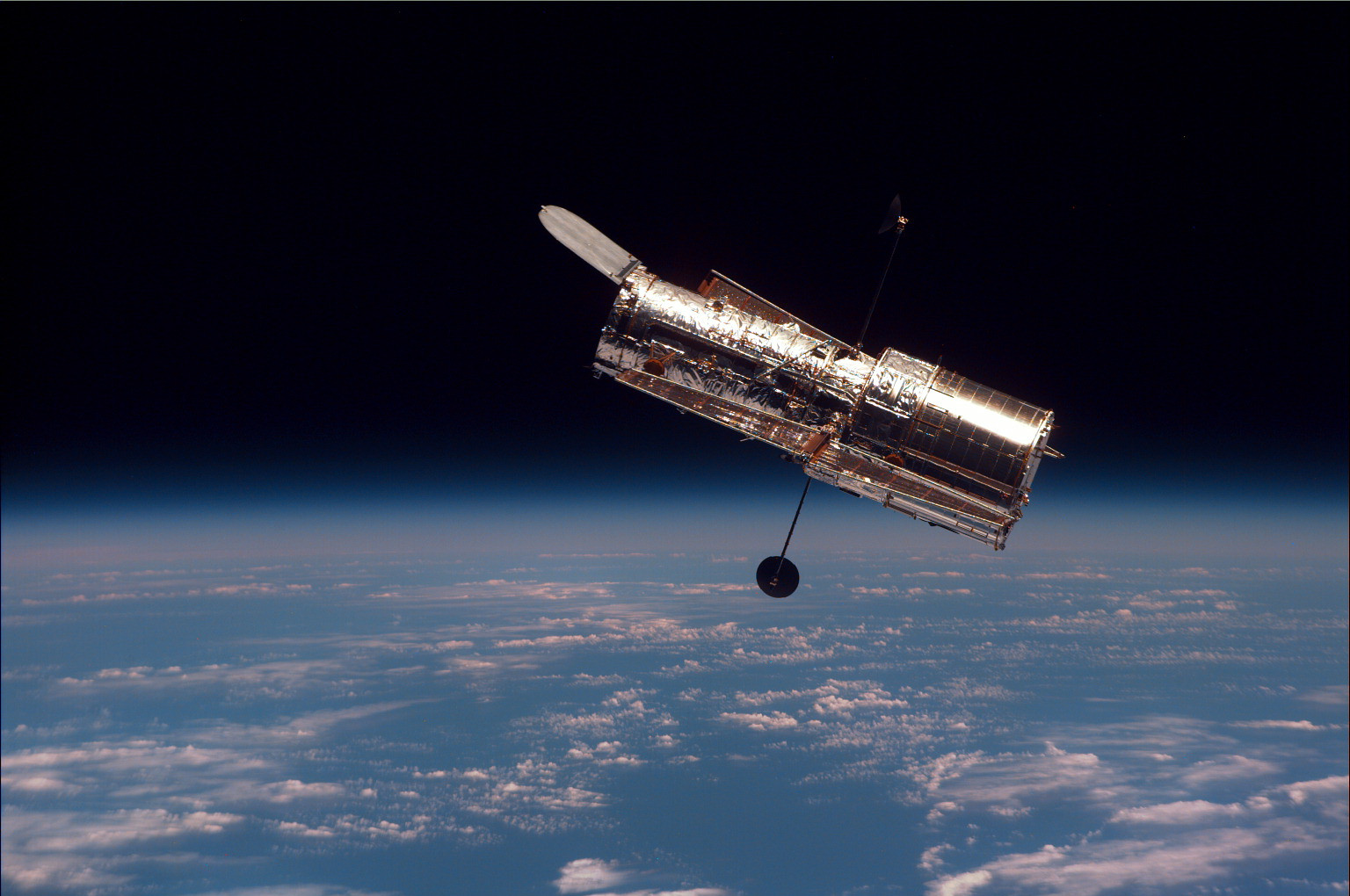
NASA issued a Request for Information Oct. 29 to learn more about industry capabilities for in-space servicing to support the agency’s Hubble Space Telescope.
“Hubble still has important science ahead of it, and we should be looking at every reasonable opportunity to keep it delivering for as long as possible,” said NASA Administrator Jared Isaacman. “If there are innovative and cost-effective ways to extend the life of an asset already on orbit, we owe it to the American taxpayer and the scientific community to explore them. Extending Hubble’s life would mean more discoveries, more science, and more opportunities to expand our understanding of the universe.”
The Request for Information seeks commercial interest in: potentially conducting a mission to boost Hubble to a higher altitude to extend its science lifetime; servicing Hubble to enhance its capabilities; or performing a safe, controlled re-entry into Earth’s atmosphere or orbital disposal at the end of Hubble’s mission.
“Hubble is a national icon that has fundamentally changed how humanity views our universe for more than 35 years,” said Nicky Fox, associate administrator, Science Mission Directorate, NASA Headquarters in Washington. “Commercial industry has rapidly evolved in recent years to offer new capabilities for in-space satellite capture and servicing. Given the time we have until Hubble’s anticipated re-entry, we are eager to explore the breadth of possibilities to boost Hubble to a higher orbit while we develop the flagship mission to follow.”
The Request for Information is available online and will remain open for responses until 3 p.m. EST, Monday, Nov. 30.
Like all spacecraft in low Earth orbit, Hubble’s altitude is slowly decreasing over time because of atmospheric drag. Hubble does not have a propulsion system to maintain its own orbit, and analysis predicts Hubble is likely to re-enter the atmosphere in the 2033 to 2034 timeframe. As such, NASA anticipates that a mission would need to take place by 2032.
The Hubble Space Telescope has been operating for more than three decades and continues to make ground-breaking discoveries that shape our fundamental understanding of the universe. Hubble is a project of international cooperation between NASA and ESA (European Space Agency). NASA’s Goddard Space Flight Center in Greenbelt, Maryland, manages the telescope and mission operations. Lockheed Martin Space, based in Denver, also supports mission operations at Goddard. The Space Telescope Science Institute in Baltimore, which is operated by the Association of Universities for Research in Astronomy, conducts Hubble science operations for NASA.
To learn more about NASA’s Hubble Space Telescope, visit:
Media Contacts:
Alise Fisher
Headquarters, Washington
202-358-2546
alise.m.fisher@nasa.gov
Claire Andreoli
Goddard Space Flight Center, Greenbelt, Md.
202-286-1940
claire.andreoli@nasa.gov
Share
Details
Related Terms
 APOD: 2026 October 31 – Night on a Spooky Planet
October 31, 2026
 NASA Releases MAX POWER Key Events for Media, Participants
October 30, 2026
 NASA’s James Webb Space Telescope Captures Eerie Cat’s Head
October 30, 2026
 November’s Night Sky Notes: Light-Day Away
October 30, 2026
 APOD: 2026 October 30 – Haunting the Cepheus Flare
October 30, 2026
 Vega Island Frozen in Fright
October 30, 2026
 Petrol and diesel prices today, November 1: Check fuel rates in different cities across India
November 1, 2026
 Rahul Gandhi rally protest today, Nov 1: Check full traffic advisory, road diversions, railway, bus, metro routes here
November 1, 2026
 India readies a new soft power playbook
November 1, 2026
 How the downfall of Serbia's Vučiċ mirrored that of Hungary's Orbán
November 1, 2026
 India's opposition set to hold mega rally seeking election chief's resignation
November 1, 2026
Daniel Wilkerson's Funny Car explodes in massive fireball during NHRA qualifying; video emerges
October 31, 2026