

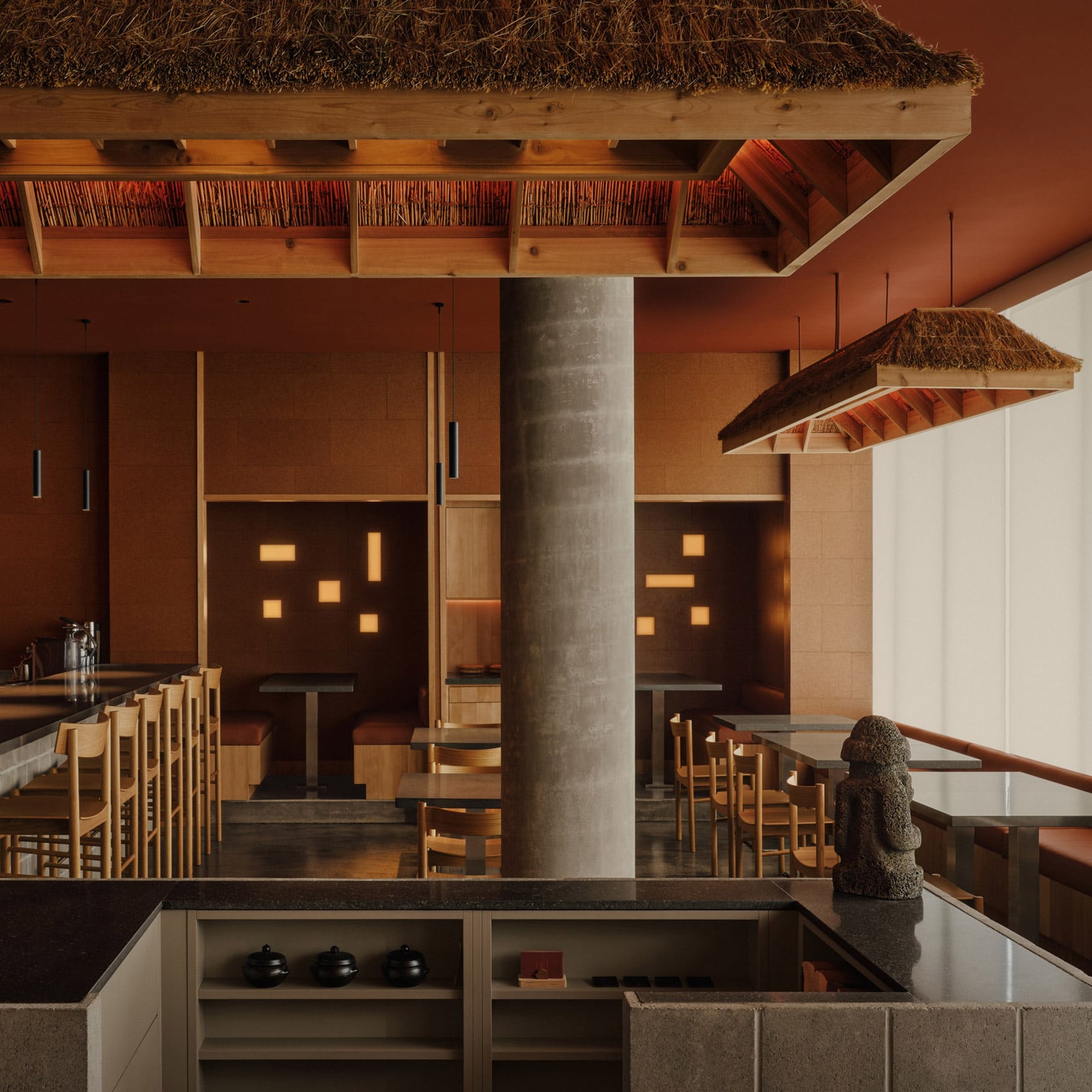
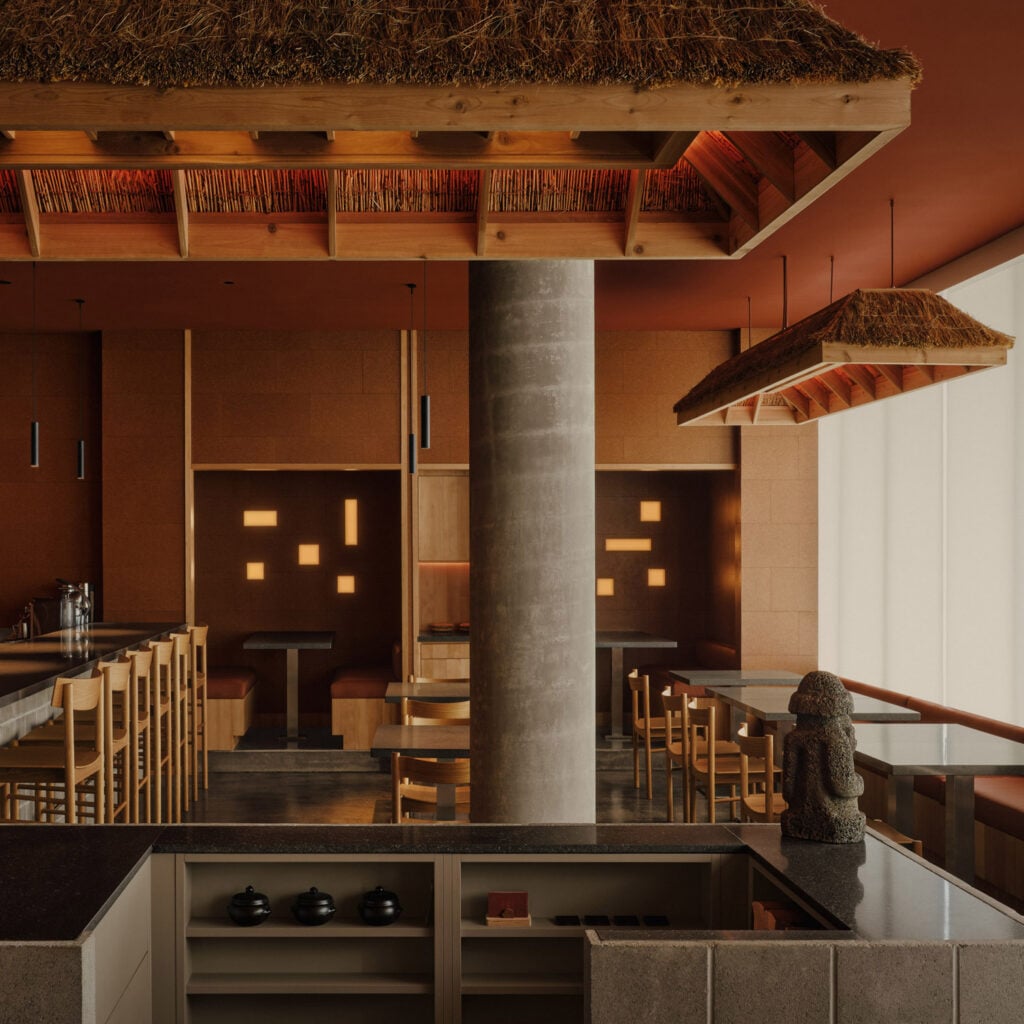
Canadian studio &Daughters used basalt, cork, concrete, thatch and wood to design Jeju, a Korean restaurant in Vancouver that features traditional touches in a contemporary interior.
The architect’s starting point for the design was the restaurant’s menu, which includes modern dishes developed by chef Dylan Kim, traditional dishes created by his mother, chef Myungseok “Julie” Suh and dishes that they created together.
“The restaurant exists in the space where these two narratives meet,” &Daughters principal Emma Sims told Dezeen.
“We began to think of tradition and reinterpretation as the foundation for the design, translating this relationship into a physical space through a specific set of people, places, materials and traditions.”
While Jeju’s exterior has a modern steel-mesh facade, the interior juxtaposes wood and concrete for a warmer, more tactile feel.
At the heart of the 44-seat restaurant is a reinterpretation of a traditional thatched house from Jeju Island, South Korea, called a chogajip.
This was constructed using lumber and hand-thatched grass, and creates an artisanal focal point for the space.
Other materials, including basalt, were chosen by &Daughters for Jeju to ensure a natural feel.
Basalt was used for the bar, chef’s table and host stand, while cork cladding helps create a soft feel while adding acoustic dampening.
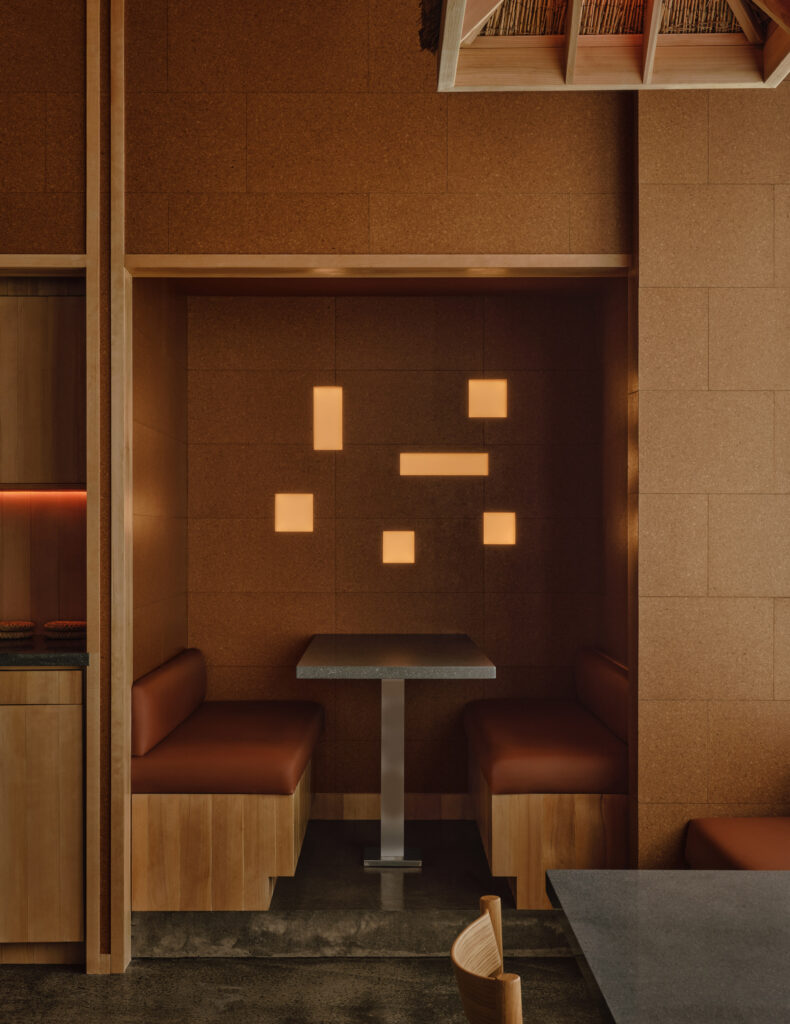
The studio kept the existing concrete floor but polished it to reveal variations in its colour.
“The palette is quite simple – basalt, cork, raw concrete masonry units, polished concrete, wood and thatch,” Sims said.
“Basalt is one of the most recognisable materials of Jeju Island,” she continued.
“Formed through volcanic activity, it is found throughout the island’s landscape, architecture and traditional stone walls. Beyond that, we were interested in materials that felt direct and unrefined, allowing them to retain their natural character.”
The studio wanted to “introduce elements of tradition, ritual and memory into the interior,” Sims said.
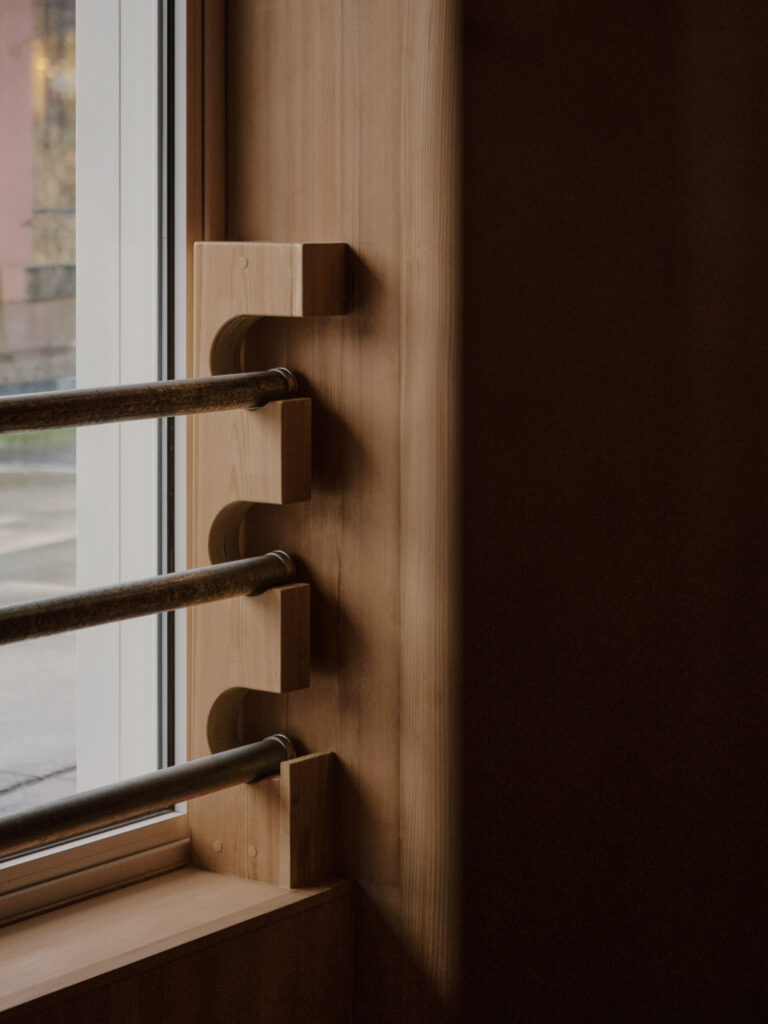
As well as the thatched house, another traditional architectural feature from Jeju, a jeongnang three-pole gate, was also introduced to the interior.
“Historically used as a means of communicating whether a household was home, away or nearby, it offered an alternative to a conventional locked entrance, rooted in trust and shared understanding,” Sims said.
“At Jeju, we incorporated our interpretation into the glazing beside the entrance, where staff lower two poles each day to signal that the restaurant is open and guests are welcome, raising them again at the end of service,” she continued.
“In this way, a traditional architectural element becomes an active part of the restaurant’s daily life.”
Other restaurants recently featured on Dezeen include a brick-clad eatery in London’s Soho area and a bistro in Montreal influenced by Japanese metabolism.
 OEB Architects channels 1980s interiors for London extension
November 4, 2026
 SOM unveils design for luxury waterfront development on Australian pier
November 4, 2026
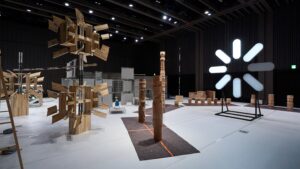 Alter design exhibition returns to Tokyo with AI-powered tea ceremony and washi paper furniture
November 4, 2026
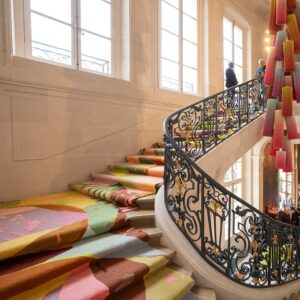 SCAD alumni transform 18th-century staircase into colourful installation during Design Miami Paris
November 4, 2026
 Tatiana Bilbao creates rammed-earth installation at Art Omi
November 3, 2026
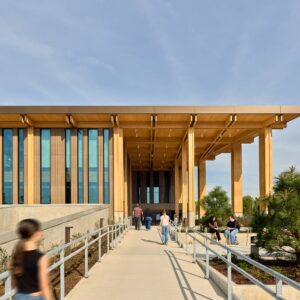 Holst completes Adjaye-designed mass-timber library in Oregon
November 3, 2026
 Kellogg's admits snap, crackle and pop is quieter after uproar over Rice Krispies recipe change
November 4, 2026
 Sonic the Hedgehog Shows Up in New Angry Birds 3 Trailer for Some Reason
November 4, 2026
 KFC Reveals Official Avengers: Doomsday Menu 'Worthy' of Dr. Doom
November 4, 2026
 The Budget-Friendly Flashforge Adventurer 5M 3D Printer Drops to a Mere $131 Ahead of Black Friday
November 4, 2026
 Watch: PM and Ed Miliband play steel drums in Antigua
November 4, 2026
 Photos: Iran marks US embassy takeover with rallies against US, Israel
November 4, 2026