

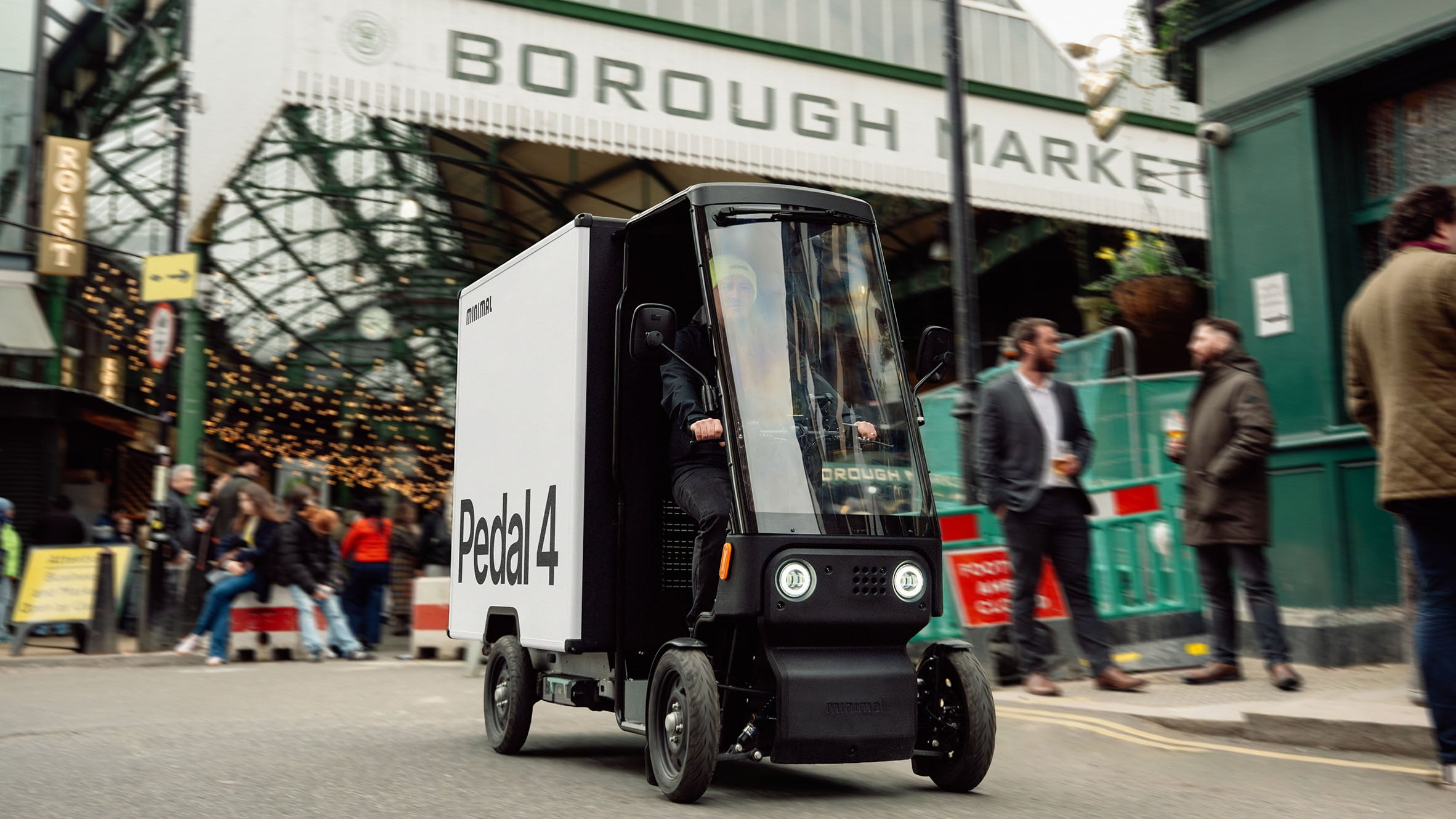
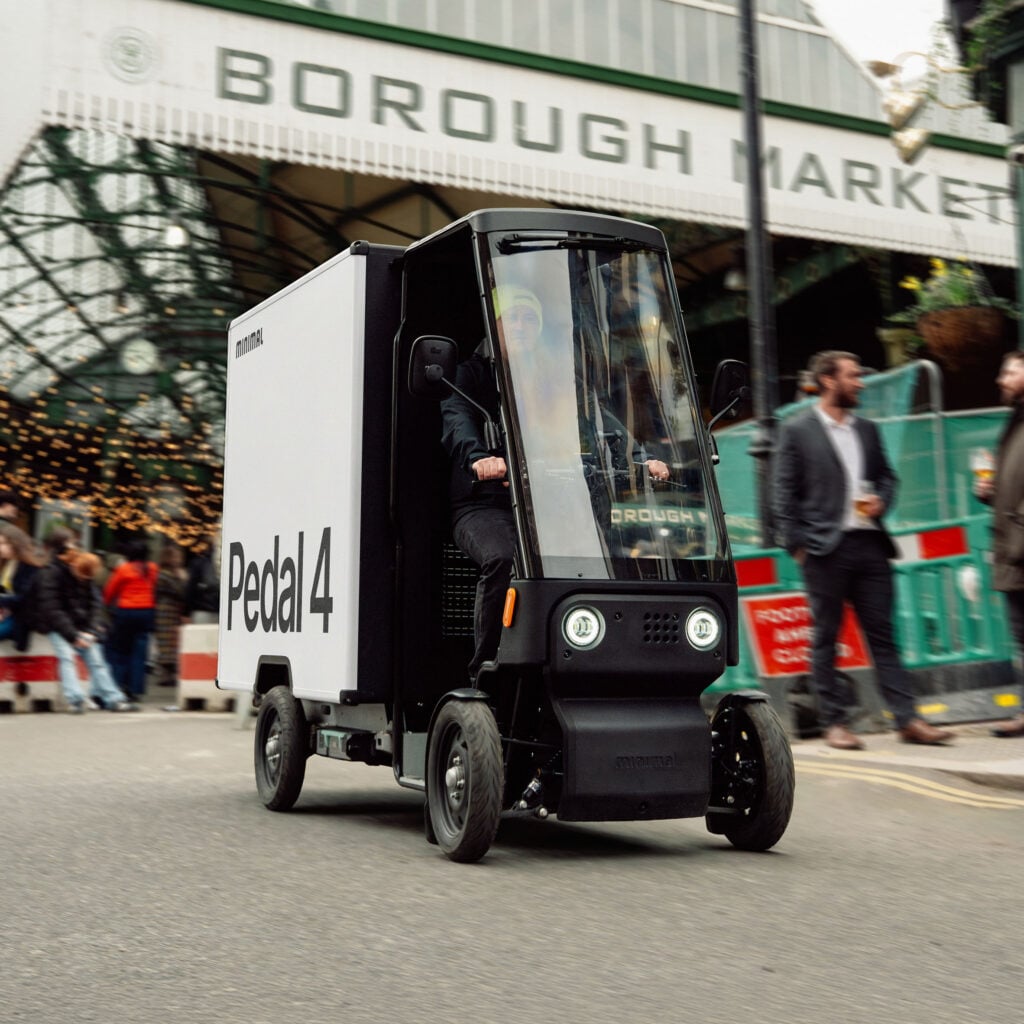
British start-up Minimal has designed an electric cargo bike with the carrying capacity of a small van in the Pedal 4, now operating in London with delivery companies Royal Mail and Evri.
Shortlisted in the consumer product design category of the 2026 Dezeen Awards, Pedal 4 was built to take up less room on the roads and evade traffic even on London’s crowded and complex streets.
The four-wheeled, pedal-assist cargo vehicle has a footprint not much larger than a bike – three metres by one metre – and is able to go down pedestrianised roads and use cycle infrastructure, according to Minimal.
Photographs

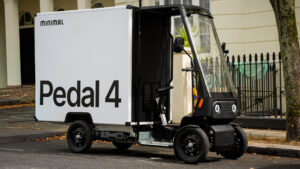

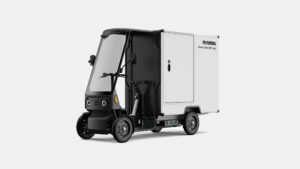
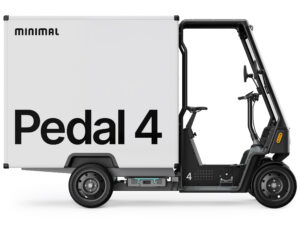

At the same time, it boasts 2.5 cubic metres of cargo space and in London trials made 36 per cent more deliveries per hour than vans.
“Electric vans solve the emissions problem, but not the access problem,” said Minimal CEO and co-founder Patrick Bion. “They still sit in the same traffic, fight for the same kerb space and need a driver with a licence.”
“They weren’t built for the job they’re doing,” he added. “We designed Pedal 4 around that job: a full round of deliveries, through streets a van can’t get down, ridden by anyone who can ride a bike.”
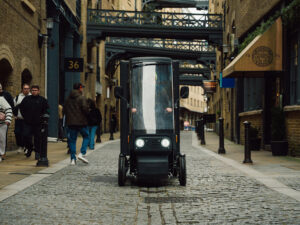
Minimal considers the Pedal 4 to be not just an electrified van or scaled-up bicycle, but a vehicle engineered specifically for delivery with an aesthetic drawn directly from its functional architecture.
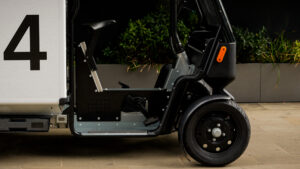
It has a four-wheeled base for stability and independent double-wishbone suspension at the front and a rubber torsion axle suspension system at the rear to help keep it level around corners, even when its cargo box is full.
The team removed the traditional bike chain, minimised fasteners and reduced part counts with the aim of making the vehicle both rugged enough for its task and easily serviceable.

They wanted the vehicle’s aesthetic to come directly from its functional architecture – an exposed zinc-coated carbon steel frame with satin black metal covers.
“Pedal 4 has to do a van’s job every day for years, so it can’t be fragile, fussy or expensive,” said Minimal product design engineer Sean Heany. “Our biggest wins came from deleting parts, not adding features.”
“By rethinking the geometry, we cut part count and fastenings, which made the vehicle tougher, quicker to fix and cheaper to build in our London microfactory.”
The Pedal 4 includes two slots for swappable batteries, which lift out to charge outside of the vehicle and together give a range of 60 kilometres.
In the UK, the vehicle is classed as a heavy-duty electrically power-assisted cycle (EPAC) and can be driven without a licence, which Minimal says widens the pool of people who can do the job.
However, Minimal believes that the future of logistics lies in autonomous and worker-driven vehicles working side by side. To that end, each Pedal 4 is equipped with the company’s FleetOS fleet management software, which tracks its route and vehicle performance.
Minimal says that the data collected will be used to make the next round of design changes and inform the company’s autonomous vehicle programme. Recently, it has launched Bot, a UK- and EU-focused delivery robot.
“Pedal 4 is where our autonomy work starts,” said Heaney. “Every vehicle is connected, and more than 100,000 kilometres of real delivery data has taught us what city logistics actually demands.”
“The same principles carry over: fewer parts, lower cost, built for uptime. They are what make autonomy work economically, not just technically.”

Pedal 4 has been engineered for, tested on and now launched on London’s streets through partners Royal Mail and Evri, but Heaney says the same vehicles and software are built to scale across Europe. The company plans to launch in the US in 2027.
“London is one of the hardest places in the world to deliver, which makes it the best place to start,” said Heaney. “If Pedal 4 works on London’s streets, it can work anywhere.”
“Cities can’t keep moving goods the way they did last century,” he continued. “We need new ways of moving things that make our cities, our environment and our everyday lives better.”
Other recent new electric vehicle typologies include the Amble One – a doorless electric buggy in the vein of a golf cart – and a three-wheeler called Trinity designed for urban travel.
 Finnegan Shannon installs conveyor belt for displaying art accessibly in Brooklyn
November 12, 2026
 Crosslam completes Brazil's tallest mass-timber tower
November 12, 2026
 EMBT shelters Naples metro station beneath "natural and welcoming" vaulted timber roof
November 12, 2026
 Faulty Wedding Cake pavilion to be dismantled at Waddesdon Manor
November 12, 2026
 RooMoo transforms abandoned mountain cabins into hotel in China
November 12, 2026
 Renovation delays pose "Notre Dame-like" fire risk for Houses of Parliament
November 12, 2026
 Candy Crush Is Celebrating Xbox’s 25th Anniversary With Halo, Fallout, And Doom Crossovers, Including Remixed Music
November 12, 2026
 New Doom Game Seemingly Announced In The Weirdest Way After Half The Studio Was Laid Off
November 12, 2026
 My Trip Down Xbox Memory Lane Should Be Celebratory, But Instead It’s Just Depressing
November 12, 2026
 The 3.96lb Lenovo Yoga 7i 16" 2-in-1 Convertible Laptop and Tablet Hybrid Drops to $650 for Black Friday
November 12, 2026
 Valheim Is Getting a Comic Book Series, and It Looks Badass
November 12, 2026